

Supreme Court Justice Pamidighantam Sri Narasimha - Notable Judgments
 Copy Link
 Share
 Save
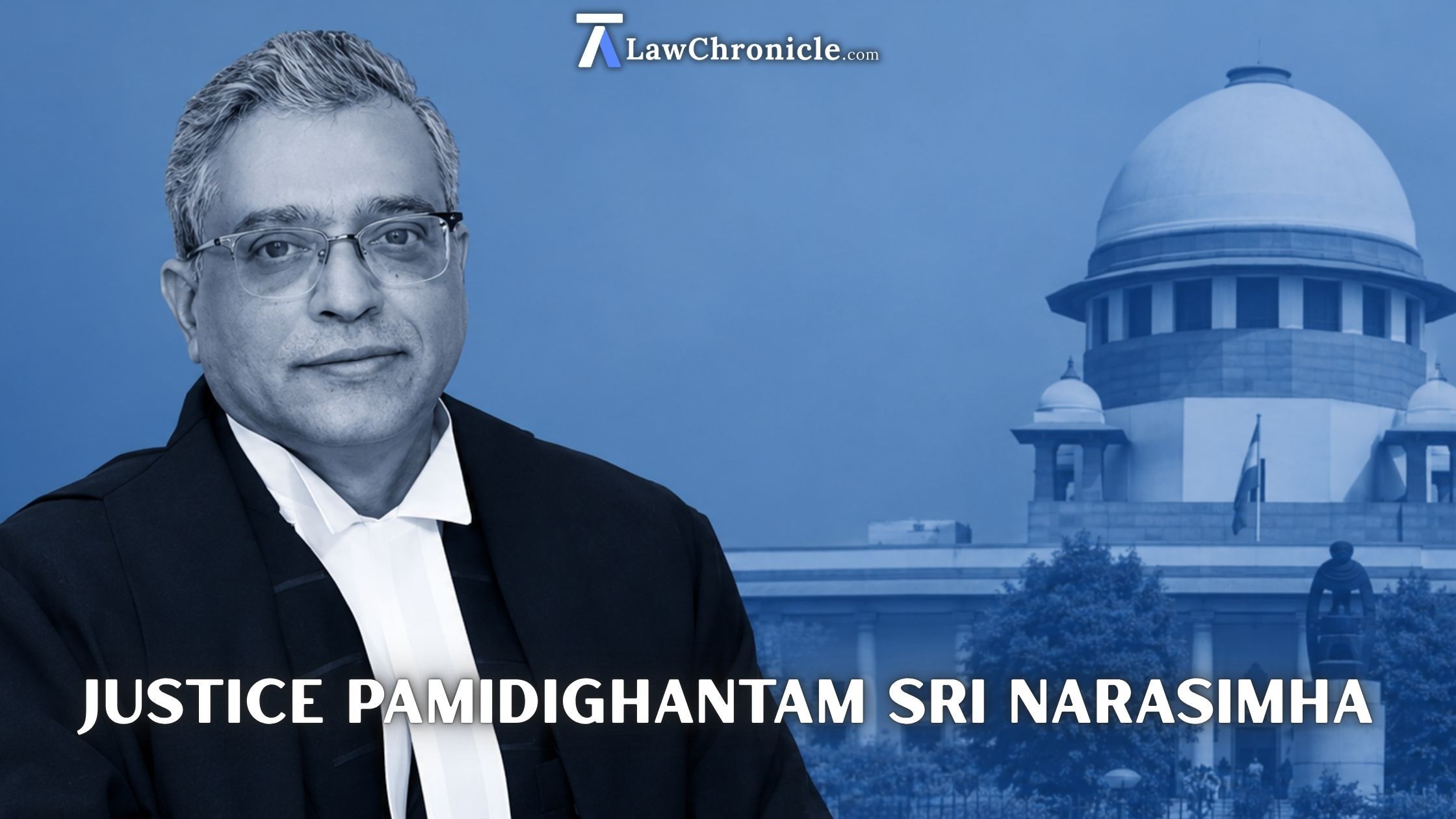
Justice Pamidighantam Sri Narasimha, born on 3 May 1963 in Hyderabad to Smt. Satyavati and the late Justice P. Kodanda Ramayya, is a Judge of the Supreme Court of India and one of the few members of the Bar to be elevated directly to the Apex Court. After completing legal studies, he enrolled with the Bar and practised before various Courts and Tribunals. Justice Narasimha was elevated to the Supreme Court of India on 31 August 2021. This article seeks to trace his journey from the Bar to the Bench and the landmark judgments that have marked his tenure.
Education and Early Career
Justice PS Narasimha completed graduation with triple majors in Economics, Political Science and Public Administration from Nizam College, Hyderabad, and studied law at the Campus Law Centre, Delhi University, completing his degree in 1988.
Enrolled as an Advocate that year, he began practice before the High Court, Civil Courts and Tribunals in Hyderabad before shifting his counsel practice to the Supreme Court of India, where he appeared in a large number of matters, including Constitution Bench cases. He was designated a Senior Advocate in 2008 and served as Additional Solicitor General of India from 2014. On 31 August 2021, he was elevated as a Judge of the Supreme Court directly from the Bar.
Notable Judgments by Justice PS Narasimha
Justice Pamidighantam Sri Narasimha has served the Bench for half a decade, having authored several judgments and has been part of coram in landmark cases. Here is a crossroad through all those important cases where Justice Narasimha traced the path of statutes and precedents to lay the foundation for further course.
Constitutional Law, Federalism and Legislative Accountability
- Re: Assent, Withholding or Reservation of Bills by the Governor and President of India, (2025 CaseBase(SC) 1445). Decided by a Constitution Bench of B.R. Gavai, CJI, Surya Kant, Vikram Nath, P.S. Narasimha and Atul S. Chandurkar, JJ., this Presidential Reference concerned the powers of the Governor under Articles 200 and 201 of the Constitution. The Court held that the discharge of the Governor's function under Article 200 is not justiciable and that the Court cannot undertake a merits review of the decision taken. However, in circumstances of prolonged, unexplained and indefinite inaction, the Court may issue a limited mandamus directing the Governor to discharge the function within a reasonable time, without commenting on the merits of the Governor's discretion.
- Government of NCT of Delhi v. Union of India (2023 CaseBase(SC) 868). A five-judge Bench, of which Justice Narasimha was a member, held that control over administration and services in Delhi vests in the elected Delhi Government and not in the Union. The Bench emphasised the federal structure of governance and the "chain of accountability" through which civil servants answer to the electorate.
- Supriyo @ Supriya Chakraborty v. Union of India (2023 CaseBase(SC) 642). A five-judge Constitution Bench of Dr D.Y. Chandrachud, CJI, Sanjay Kishan Kaul, S. Ravindra Bhat, Hima Kohli and P.S. Narasimha, JJ., delivered four opinions on the marriage equality petitions. All the Judges held that there is no fundamental right to marry and that the Court could not read words into the Special Marriage Act, 1954 to make it gender-neutral, leaving the matter to Parliament. In his separate concurring opinion, Justice Narasimha observed that marriage is governed by customary practices and religious beliefs found in personal law. He held that the petitioners' demand would place positive legislative obligations on the State and could not be acceded to, and that directing the State to grant legal recognition to "unions" carrying benefits would in effect amount to amending statutory frameworks or legislating afresh, violating the separation of powers. Justices Bhat, Kohli and Narasimha formed the majority on the points on which the Bench divided; the Chief Justice and Justice Kaul dissented on those points.
- Sita Soren v. Union of India, (2024 CaseBase(SC) 253). A seven-judge Constitution Bench of Dr D.Y. Chandrachud, CJI, A.S. Bopanna, M.M. Sundresh, P.S. Narasimha, J.B. Pardiwala, Sanjay Kumar and Manoj Misra, JJ., unanimously held that Members of Parliament and State Legislatures are not immune from prosecution for bribery relating to votes cast or speeches made in the House, and do not enjoy protection under Articles 105(2) and 194(2). The ruling overturned the five-judge Bench decision in P.V. Narasimha Rao v. State (CBI/SPE), (1998).
Arbitration Law
- Central Organisation for Railway Electrification v. ECI-SPIC-SMO-MCML (JV), (2024 CaseBase(SC) 3691). A five-judge Bench of Dr D.Y. Chandrachud, CJI, Hrishikesh Roy, J.B. Pardiwala, P.S. Narasimha and Manoj Misra, JJ., heard references questioning the correctness of Central Organisation for Railway Electrification v. ECI-SPIC-SMO-MCML (JV), (2019 CaseBase(SC) 23), on unilateral appointment of arbitrators and on whether an ineligible person can nominate an arbitrator. The Bench held that unilateral appointment clauses in public-private contracts violate Article 14 of the Constitution.
- Cox & Kings Ltd. v. SAP India (P) Ltd., (2023 CaseBase(SC) 947). A five-judge Bench of Dr D.Y. Chandrachud, CJI, Hrishikesh Roy, P.S. Narasimha, J.B. Pardiwala and Manoj Misra, JJ., unanimously upheld the application of the "Group of Companies" doctrine in Indian arbitration jurisprudence. In his concurring opinion with supplemental reasoning, Justice Narasimha explained that the doctrine rests on the mutual intention of the parties and is fundamentally different from piercing the corporate veil or the alter ego principle, since applying it does not lift the corporate veil. He concluded that the doctrine applies, irrespective of the distinct juridical identities of group members, where they share a common economic reality through their role in the formation, performance and termination of the contract.
- State of Jharkhand v. Indian Builders, (2025 CaseBase(SC) 1359). A Bench of P.S. Narasimha and Atul S. Chandurkar, JJ., found that the law laid down in Bharat Drilling & Foundation Treatment Pvt. Ltd. v. State of Jharkhand, (2009), on the applicability of prohibited claim clauses to arbitral tribunals, requires reconsideration, as it is not in tune with Cox and Kings Ltd. v. SAP India Pvt. Ltd., (2023 CaseBase(SC) 947) and In re: Interplay Between Arbitration Agreements under the Arbitration and Conciliation Act, 1996 and the Stamp Act, 1899, (2023 CaseBase(SC) 944). The matter was referred to a larger Bench.
- Rajia Begum v. Barnali Mukherjee, (2026 CaseBase(SC) 95). A Bench of P.S. Narasimha and Alok Aradhe, JJ., held that a dispute cannot be referred to arbitration where the document containing the arbitration clause is itself alleged to be forged, as such a controversy goes to the root of arbitral jurisdiction and is non-arbitrable. The Court held that the High Court, in exercising jurisdiction under Article 227, was not justified in reappreciating evidence and disturbing concurrent findings, and affirmed the High Court's order refusing appointment of an arbitrator under Section 11 of the Arbitration and Conciliation Act, 1996.
- Adavya Projects (P) Ltd. v. Vishal Structurals (P) Ltd., (2025 CaseBase(SC) 931). A Bench of P.S. Narasimha and Manoj Misra, JJ., held that a notice invoking arbitration under Section 21 of the 1996 Act is mandatory, as it fixes the date of commencement of arbitration and is a pre-requisite to an application under Section 11. However, non-issuance of notice to certain parties to the arbitration agreement does not strip the arbitral tribunal of jurisdiction to implead them during the proceedings.
- Glock Asia-Pacific Ltd. v. Union of India, (2023 CaseBase(SC) 895). A three-judge Bench of Dr D.Y. Chandrachud, CJI, P.S. Narasimha and J.B. Pardiwala, JJ., appointed Justice Indu Malhotra, a former Judge of the Supreme Court, as sole arbitrator under Section 11(6). The Court held that a contract entered into in the name of the President cannot create immunity against statutory conditions imposed on parties to an agreement when the Government chooses to enter into a contract.
- NTPC Ltd. v. SPML Infra Ltd., (2023 CaseBase(SC) 399). A Bench of Dr D.Y. Chandrachud, CJ and P.S. Narasimha, J., held that the Delhi High Court erred in allowing an application under Section 11(6) without examining the question of final settlement of disputes in light of the principles in Vidya Drolia v. Durga Trading Corpn., (2019), thereby explaining the scope of the High Court's pre-referral jurisdiction.
- Serosoft Solutions (P) Ltd. v. Dexter Capital Advisors (P) Ltd., (2025 CaseBase(SC) 174). A Bench of P.S. Narasimha and Manoj Misra, JJ., stressed judicial restraint in arbitration matters, holding that the High Court was not justified in exercising supervisory jurisdiction under Article 227 to grant a further opportunity to cross-examine a witness when it had not indicated why the Tribunal's order was perverse.
Property, Regulatory and Public Law
- Kolkata Municipal Corpn. v. Bimal Kumar Shah, (2024 CaseBase(SC) 35). A Bench of P.S. Narasimha and Aravind Kumar, JJ., upheld the Calcutta High Court's holding that Section 352 of the Kolkata Municipal Corporation Act, 1980 confers no power of compulsory acquisition. Interpreting "authority of law" in Article 300-A, the Bench held that the minimum content of the constitutional right to property comprises seven sub-rights or procedures: notice, hearing, a reasoned decision, acquisition only for a public purpose, fair compensation, efficient conduct of the process within timelines, and conclusion of the proceedings.
- BSES Rajdhani Power Ltd. v. Union of India, (2025 CaseBase(SC) 842). A Bench of P.S. Narasimha and Sandeep Mehta, JJ., dealt with the creation and continuation of a "regulatory asset" in Delhi's retail electricity tariff. The Court held that electricity is a public good governed by the Directive Principles in Part IV, that regulatory commissions and governments are equally bound by that mandate, and that disproportionate and prolonged regulatory assets indicate regulatory failure. It cautioned against regulatory capture and stressed the independence, efficiency and objectivity of commissions.
- All India Football Federation v. Rahul Mehra, (2025 CaseBase(SC) 1011). A Bench of P.S. Narasimha and Joymalya Bagchi, JJ., approved the Draft Constitution of the All India Football Federation and directed the AIFF administration to convene a special general body meeting to adopt it, with the modifications made in the judgment, preferably within four weeks.
- Rutu Mihir Panchal v. Union of India, (2025 CaseBase(SC) 1050). A Bench of P.S. Narasimha and Manoj Misra, JJ., dismissed the challenge to Sections 34(1), 47(1)(a)(i) and 58(1)(a)(i) of the Consumer Protection Act, 2019, which fix the pecuniary jurisdiction of consumer commissions by the value of consideration paid, and held them neither violative of Article 14 nor manifestly arbitrary. The Court also directed the Central Consumer Protection Council and the Central Consumer Protection Authority to take necessary measures to review and advise on effective redressal.
- Sukh Dutt Ratra v. State of H.P., (2022 CaseBase(SC) 1094). A Bench of S. Ravindra Bhat and P.S. Narasimha, JJ., held that the State cannot rely on delay and laches to evade its responsibility towards persons whose private property it has expropriated, observing that there cannot be a limitation on doing justice.
Service, Consumer, Commercial and Social Welfare Matters
- Union of India v. Rohith Nathan, (2026 CaseBase(SC) 195). A Bench of P.S. Narasimha and R. Mahadevan, JJ., upheld the Madras, Delhi and Kerala High Court judgments directing reconsideration of OBC candidates' creamy layer status in the Civil Services Examination, where parental income from PSUs, banks or private organisations had been treated differently from that of Government servants, in terms of the Office Memorandum dated 8 September 1993.
- Mukesh Kumar v. Union of India, (2022 CaseBase(SC) 271). A three-judge Bench of U.U. Lalit, S. Ravindra Bhat and P.S. Narasimha, JJ., held that a Railway Board circular denying compassionate appointment to children born from the second wife of a deceased employee is discriminatory, and that an applicant cannot be denied consideration only because he is the son of the second wife.
- S.D. Jayaprakash v. Union of India, (2025 CaseBase(SC) 384). A Bench of P.S. Narasimha and Joymalya Bagchi, JJ., held that on regularisation, Rule 17 of the Central Civil Services (Pension) Rules, 1972 requires past contractual service to be counted for pension, and directed the Union of India to grant pensionary benefits accordingly.
- Irwan Kour v. Punjab Public Service Commission, (2025 CaseBase(SC) 605). A Bench of P.S. Narasimha and Manoj Misra, JJ., held that personnel of the Indian Military Nursing Service fall within the "ex-servicemen" category for State reservation in public employment.
- Sonali Power Equipments (P) Ltd. v. Maharashtra SEB, (2025 CaseBase(SC) 522). A Bench of P.S. Narasimha and Joymalya Bagchi, JJ., held that the Limitation Act, 1963 does not apply to conciliation proceedings under Section 18(2) of the MSMED Act, 2006, and that a time-barred claim can be referred to conciliation since expiry of limitation does not extinguish the right to recover the amount.
- Yash Raj Films (P) Ltd. v. Afreen Fatima Zaidi, (2024 CaseBase(SC) 169). A Bench of P.S. Narasimha and Aravind Kumar, JJ., set aside the NCDRC order, holding that promotional trailers are unilateral and are not offers eliciting acceptance, and therefore do not become enforceable promises, and that no unfair trade practice was made out.
- Jaya Thakur v. Government of India, (2023 CaseBase(SC) 228). A three-judge Bench of Dr D.Y. Chandrachud, CJ, P.S. Narasimha and J.B. Pardiwala, JJ., directed all States and Union Territories to submit their menstrual hygiene management strategies and plans and to ensure disposal mechanisms for sanitary pads in school complexes.
- K.C. Cinema v. State of Jammu and Kashmir, (2023 CaseBase(SC) 111). A Bench of Dr D.Y. Chandrachud, CJ and P.S. Narasimha, J., set aside the Jammu and Kashmir High Court's order, holding that cinemagoers are bound by the conditions of entry set by theatre owners, including the prohibition on carrying outside food and beverages.
Criminal Law, Civil Liberties and Technology
- Gummadi Usha Rani v. Sure Mallikarjuna Rao, (2026 CaseBase(SC) 2139). A Bench of P.S. Narasimha and Alok Aradhe, JJ., took cognizance of the use of AI-generated, non-existent or synthetic precedents in a trial court order and issued notice to the Attorney General for India, the Solicitor General of India and the Bar Council of India to examine the systemic implications for the integrity of judicial decision-making.
- Sivakumar v. State, (2026 CaseBase(SC) 3803). A Bench of Manoj Misra and P.S. Narasimha, JJ., partly allowed the appeals arising from a fatal incident following a boundary dispute between relatives, and held that mere use of abusive language in a heated altercation is not "obscenity" under Section 294(b) IPC, setting aside the conviction on that count.
- Sujoy Ghosh v. State of Jharkhand, (2026 CaseBase(SC) 227). A Bench of P.S. Narasimha and Alok Aradhe, JJ., allowed the appeal of the director of Kahaani 2, holding that no copyright infringement arose, as the complainant's script "Sabak" did not exist when the appellant registered his screenplay.
- Devu G. v. State of Kerala, (2024 CaseBase(SC) 445). A three-judge Bench of Dr D.Y. Chandrachud, CJ, P.S. Narasimha and J.B. Pardiwala, JJ., stayed a Kerala High Court order directing a woman in a same-sex relationship, whose habeas corpus petition alleged illegal detention by her parents, to undergo counselling.
- B.A. Umesh v. Union of India, (2022 CaseBase(SC) 343). A three-judge Bench of Uday Umesh Lalit, S. Ravindra Bhat and P.S. Narasimha, JJ., on an allegation of solitary confinement of a death row convict, directed a local inspection by a District Judge to report on the ground situation.
- Ramesh Chandra Srivastava v. State of U.P., (2021 CaseBase(SC) 177). A Bench of K.M. Joseph and P.S. Narasimha, JJ., reiterated that the power under Section 319 CrPC should be exercised only where strong and cogent evidence emerges against a person, and not in a casual or cavalier manner.
 Breaking News